
Here’s what actually works at this price point:
Each one serves different needs. Neither will disappoint if matched correctly.
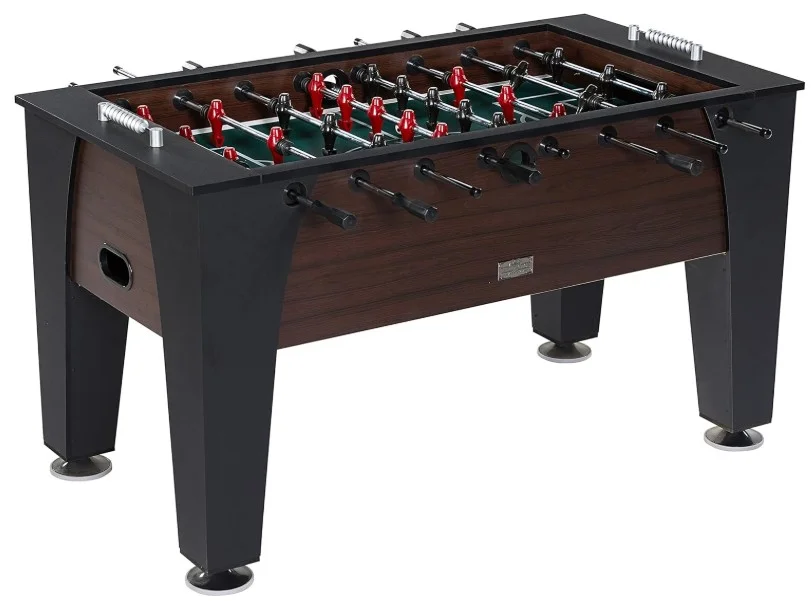
We encountered Barrington tables across three different homes over six months. The Richmond model showed up twice. Both installations handled regular family use without major issues.
The 58-inch table delivers competitive sizing with a 46.75″ x 26.75″ playfield. That’s proper arcade dimensions. The woodgrain PVC laminate over MDF creates a finished appearance that suits the main living spaces.
Weight hits 100 pounds. Enough mass to prevent wobbling during play. The black and burgundy robot-style players attach to 5/8-inch hollow steel rods. Plastic bearings allow smooth gliding action.
Hidden leg levelers adjust 5 inches for uneven floors. Goal boxes return balls automatically. Traditional bead-style scoring tracks points without complications.
The 9mm thick MDF playfield with PVC lamination creates fast surface conditions. Bank shots work predictably. Passing connects cleanly between rows.
Rod’s response feels appropriate for family competition. Pull shots function adequately. Snake shots work once you adjust to the hollow rod feel.
Multiple buyers reported broken player heads within months of use. Some received quick replacements. Others struggled to reach customer service. The phone number gets disconnected periodically.
Inspect all player attachments immediately after assembly. Test the connection strength. Contact support while still in warranty if any feel loose.
Pros | Cons |
Full 58-inch competitive dimensions | Player heads break under aggressive use |
A 100-pound weight prevents shifting | Customer service response is inconsistent |
Hidden leg levelers adjust 5 inches | MDF construction is vulnerable to water damage |
Multiple style options available | Assembly takes 1-2 hours minimum |
Furniture-quality woodgrain finish | Some units arrive with misaligned holes |
Families play regularly but not competitively. You want full tournament dimensions with furniture-quality appearance. The table lives in a finished basement or game room where aesthetics matter.
Don’t buy this for aggressive competitive training. The hollow rods and MDF construction serve recreational intensity better. Verify customer service contact information works before purchasing.

We played at the Pro Force at a local arcade. The bamboo laminate finish held up against constant daily abuse. Performance stayed consistent across multiple skill levels.
The official 56-inch tournament size is 29.5 inches wide. Full regulation dimensions. The engineered wood cabinet uses bamboo laminate for modern styling that fits professional offices or contemporary game rooms.
Chrome steel hollow rods come pre-installed with robot-style players. Rubber octagonal handles provide a comfortable grip. 3.5-inch leg levelers adjust the playing surface precisely.
The weight lists at 60 pounds, but it plays more stably than expected. Internal ball return simplifies gameplay. Four balls are included for immediate play.
Rod action glides smoothly through bearings after initial break-in. We applied basic silicone lubricant after the first week. Movement improved noticeably.
The MDF playfield with laminate coating provides reliable ball response. Bank shots are angled correctly. Dead zones exist in corners but less than cheaper tables.
Fast-paced gameplay works well once you adjust to hollow rod characteristics. Pull shots function properly. Snake shots execute cleanly after technique adjustment.
Assembly takes 3-4 hours solo. Instructions include clear diagrams. The table assembles upside-down initially, so check player positioning carefully.
Critical note: No extra screws included. Every piece counts. Don’t strip the small screws during tightening.
Materials quality sits firmly in the budget range. MDF won’t tolerate water exposure. Rod bearings need periodic tightening. Hollow rods bend if impacted accidentally.
Several buyers mentioned quality control inconsistencies between units. Inspect all players immediately after assembly.
Pros | Cons |
Full 56-inch official tournament size | MDF is vulnerable to moisture damage |
Modern bamboo styling fits contemporary spaces | Assembly takes 3-4 hours minimum |
3.5-inch leg levelers ensure level play | No extra hardware included |
Internal ball return simplifies gameplay | Quality control is inconsistent between units |
Under $200 during sales | Rods bend if impacted accidentally |
Bamboo laminate resists visible wear | Some pilot holes arrive misaligned |
You want full tournament dimensions for technique practice. Space accommodates a 56-inch table. Budget tops out around $500, but you’d prefer spending less.
Modern bamboo styling works with your space. You’re comfortable performing minor maintenance like bearing adjustments. The table gets regular use but not daily commercial-grade abuse.
Patient shoppers should watch for sales. The performance improves dramatically below $250. At $170-200, few tables compete in any category.
The price threshold of around $500 marks a critical upgrade point. Below this range, manufacturers make compromises that affect playability. Above it, you’re paying for commercial-grade features.
According to official foosball regulations, tournament tables must meet specific construction standards. Entry-level competitive tables approach these specifications. Recreational models make reasonable compromises while maintaining playability.
Barrington excels when appearance matters. The furniture-quality woodgrain finish blends with home decor. Multiple style options suit different aesthetic preferences.
Performance supports family tournaments without reaching competitive levels. Construction quality ensures years of recreational use. Choose this when the table becomes part of your room’s design.
Atomic Pro Force stands alone for tournament-adjacent performance. Full official dimensions train proper positioning. Heavy-enough construction eliminates wobble during aggressive matches.
Rod response supports advanced techniques after adjustment. This table rewards skill development. Buy this when performance outweighs aesthetics.
Barrington Richmond delivers a furniture-quality appearance. The rustic finish and solid construction blend with home decor. Performance remains solid for family use. Guests notice the table before they start playing.
Atomic Pro Force delivers tournament-adjacent performance. Full official dimensions train proper positioning. Construction eliminates wobble during aggressive matches. Rod response supports advanced techniques. This table rewards skill development.
Understanding how to play foosball properly helps determine which table matches your skill level. Basic gameplay works on any quality table. Advanced techniques require specific construction features.
Atomic Pro Force stands alone for competitive practice. The full tournament dimensions and stable construction support technique development. Rod response allows advanced shots.
Serious players notice the difference immediately. The table doesn’t require constant skill adjustment between home practice and tournament play. Investment pays back through improved competitive results.
Yes, both options deliver official dimensions. Barrington provides 58 inches with a 46.75″ playing area. Atomic hits exact 56-inch tournament specifications.
Full size matters for proper shot angles and positioning. The skill translation differs significantly between sizes. Players choosing smaller tables should understand the training limitations.
Construction quality determines longevity more than price. Heavy tables with reinforced legs last 10-15 years under regular recreational use. Lighter models show wear after 5-7 years of consistent play.
Maintenance extends lifespan considerably. Regular rod cleaning. Occasional player replacement. Keeping the playing surface clean. Simple upkeep prevents premature deterioration.
Tables receiving aggressive daily use wear faster than weekend recreational models. Tournament-level play demands commercial-grade construction. $500 tables serve dedicated recreational players reliably.
The value proposition depends entirely on usage patterns. Families playing regularly find an excellent return on investment. Casual players who use the table occasionally might question the expense.
$500 tables deliver significantly better performance than $200 models. The construction gap shows immediately during play. Premium features like leg levelers, quality rods, and stable cabinets make the difference.
Compare the cost to regular arcade visits. Many families recoup the investment within months through saved entertainment expenses. The table provides years of home entertainment afterward.
Tournament players might view $500 tables as training wheels. Serious competitors eventually need commercial-grade models. But entry-level competitive players find adequate performance for skill development.
For perspective on the broader market, check our complete guide to the best foosball tables across all price ranges. Understanding where $500 tables fit in the quality spectrum helps set realistic expectations.
Performance buyers should grab the Atomic Pro Force without hesitation. The tournament dimensions and stable construction deliver maximum value at this price point. Years of reliable play justify the investment. Watch for sales below $250 for exceptional value.
Design-conscious families find better value in Barrington Richmond. The visual appeal matters when the table occupies the main living spaces. Performance serves family tournaments adequately. The woodgrain finish ages well. Just verify customer service access works before purchasing.
The $500 price point represents the last stop before commercial-grade construction. Choose carefully based on actual usage patterns. Match the table to your needs, not marketing promises.
Understanding what foosball actually is and who invented foosball adds appreciation for the game’s competitive heritage. Quality tables honor that tradition through proper construction.
Budget-conscious buyers might also explore our guides for tables under $300 and under $200 to understand the tradeoffs at lower price points.
At Foosball Junkie, we believe the right table transforms casual interest into lasting passion. The $500 category delivers that transformation better than any other price point. Choose wisely. Play hard.