Atomic has built a recognizable identity without chasing professional tournament prestige.
Its tables combine full-size play, bold styling, practical features, and home-friendly construction. However, those strengths do not make every Atomic foosball table equally good.
This Atomic foosball table review examines the brand itself, using the Azure, Gladiator, and Pro Force as supporting examples.
Atomic Sports Brand Overview
Atomic Sports is part of Escalade’s indoor games portfolio.
The brand produces foosball, air hockey, shuffleboard, basketball shootouts, and billiards equipment. Escalade describes Atomic as a feature-driven game table brand known for visual extras, including LED lighting.
That positioning matters.
Atomic does not appear to build primarily for professional foosball clubs. Its tables target buyers who want substantial home equipment with more presence than a basic starter table.
Typical Atomic buyers include:
- Families upgrading from a small foosball table
- Adults creating a dedicated recreation space
- Offices wanting a full-size football table
- Casual players who value design and convenience
- Buyers comparing manual and electronic features
In practical terms, Atomic sits between lightweight entry tables and specialized competition equipment.
The products feel more substantial than toys. However, they should not automatically be treated as professional table soccer equipment.
Are Atomic Foosball Tables Good?
Atomic foosball tables are generally good for recreational home use.
Their strongest qualities include full-size cabinets, steel rods, adjustable levelers, ball-return systems, and distinctive designs.
The brand also offers meaningful variety.
The Azure focuses on lighting and electronics. The Gladiator emphasizes weight and solid rods. The Pro Force offers a simpler, more accessible design.
That range is useful, but it also creates inconsistency.
An Atomic foosball table review should never judge the entire brand from one model. Cabinet weight, rod type, handles, scoring, and durability can vary considerably.
For most home buyers, Atomic offers a reasonable balance of:
- Recreational performance
- Visual appeal
- Adult-friendly dimensions
- Useful convenience features
- Accessible gameplay
- Moderate long-term maintenance
The brand becomes less convincing when buyers expect tournament-level control, commercial durability, or solid-wood construction.
Atomic tables can deliver enjoyable table soccer. They are not automatically substitutes for certified competition tables.
Common Features of Atomic Foosball Tables
Atomic does not use one identical formula across every model. Still, several design patterns appear throughout the range.
| Common Atomic feature | What it means for buyers |
| Full-size cabinet | Adults can play comfortably without using a miniature table |
| Engineered wood or MDF | Keeps the table practical, but requires protection from moisture |
| Steel player rods | Provides better strength than lightweight plastic systems |
| Adjustable leg levelers | Helps correct an uneven playing surface |
| Built-in ball return | Reduces interruptions after goals |
| Manual or electronic scoring | Gives buyers traditional and modern options |
| Two to four-player layouts | Supports singles and doubles play |
| Assembly-required design | Reduces shipping size but increases setup responsibility |
The current Atomic models confirm this general pattern. Azure uses steel rods and electronic scoring. Gladiator uses solid steel rods and manual abacus scoring. Pro Force uses hollow chrome rods and a manual sliding scorer.
These features make Atomic relatively easy to understand.
The cabinets differ, but the brand keeps returning to full-size recreational play with adjustable support and built-in scoring.
Atomic Foosball Table Build Quality
Build quality is where Atomic deserves a balanced assessment.
The brand offers respectable home construction, but it does not use the same hardware across every Atomic foosball table.
Cabinet and Frame Construction
Most Atomic foosball tables use MDF or engineered wood.
This material can create a stable cabinet without the cost or weight of solid hardwood. It also allows Atomic to apply modern finishes and dramatic styling.
However, MDF has clear limitations.
Moisture can cause swelling. Overtightened hardware can damage screw points. Repeated movement may loosen connections faster than on a commercial cabinet.
Proper assembly matters as much as the material itself.
A well-assembled Atomic table can remain stable during normal home play. A poorly aligned cabinet may develop movement, uneven ball travel, or loose legs.
The Azure adds alloy steel components and weighs about 116.7 pounds, based on the supplied product specifications.
The Gladiator is also notably heavy. Its listed weight is approximately 53 kilograms.
The Pro Force is lighter at around 60 pounds. That makes it easier to manage, but less resistant to aggressive body movement.
Weight does not guarantee quality, but it often improves stability.
Rods, Handles, and Players
Atomic uses several rod and handle combinations.
The Gladiator uses solid steel rods with solid wood handles. The current Pro Force uses hollow chrome steel rods with rubber handles. Azure uses 15.8 mm steel rods.
These differences affect gameplay.
Solid rods feel heavier. They can make the table feel planted, but they require more effort to accelerate.
Hollow rods usually feel quicker. Beginners may find them easier to move, although the lighter response can feel less controlled during forceful play.
Handle material also changes the experience.
Wood handles feel firm and direct. Rubber handles can feel more comfortable during longer sessions. Neither choice is universally better.
Player design deserves attention too.
The Pro Force uses robot-style players. The Gladiator has a more traditional appearance. Buyers should inspect the player foot, not only the figure’s color.
A broad, rounded foot may struggle with controlled pins and precise passes.
That matters to improving players.
A beginner may enjoy fast shooting immediately. A more technical player may notice the limitation after developing better ball control.
Playfield and Leveling
An attractive cabinet means little if the ball constantly rolls toward one corner.
Atomic addresses this with adjustable leg levelers across its main full-size models.
The Gladiator and Pro Force use 3.5-inch levelers. These allow buyers to compensate for carpet, basement floors, and minor surface differences.
Levelers cannot correct a warped playfield.
Before final assembly, inspect the playing surface for visible curves, lifted edges, or damage. Test the table again after moving it into position.
A small carpenter’s level can save many arguments.
Otherwise, every losing player will suddenly become a flooring expert.
Atomic Foosball Table Gameplay Experience
Atomic’s gameplay is designed around accessibility.
The tables support fast shooting, casual passing, family matches, and doubles play. Most adults can use them comfortably.
Rod movement varies by model.
The Pro Force feels lighter because of its hollow rods. The Gladiator feels heavier and more deliberate. Azure combines arcade-style play with electronic feedback.
For beginners, these differences may seem minor.
After several months, they become more noticeable.
Players developing controlled passes will care about:
- Player-foot shape
- Rod resistance
- Handle grip
- Playfield consistency
- Ball texture
- Cabinet movement
- Dead spots near the walls
Atomic performs best when buyers want enjoyable recreational play.
Its tables can support friendly competition and basic skill development. However, Atomic is not listed among the five official tables named for the 2026 International Table Soccer Federation World Champions League.
That does not make Atomic a bad brand.
It simply defines the intended use.
A home football table should be judged by home priorities. Tournament equipment should be judged by competition standards.
Atomic Azure LED
View Product
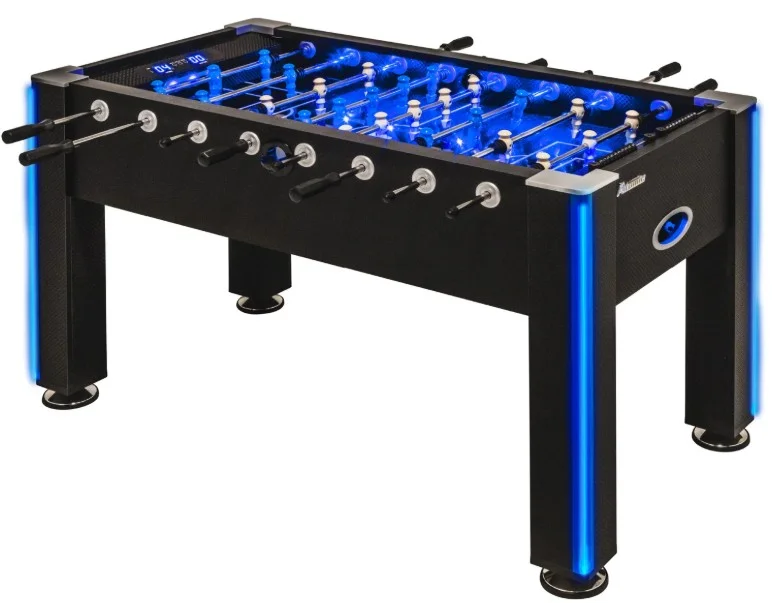
The Atomic Azure LED Foosball Table represents the brand at its most theatrical.
It includes illuminated rails, goals, legs, an LED ball, game music, and automatic electronic scoring. The playfield measures 47 by 27 inches, while the rods measure 15.8 mm.
These features create an engaging atmosphere.
They also introduce additional cables, connectors, lights, and scoring components.
A traditional manual scorer has almost nothing to troubleshoot. An electronic system can require power checks, cable inspection, or replacement components.
The Azure therefore suits buyers who genuinely value its illuminated experience.
Anyone indifferent to lighting may be paying for complexity they do not need.
Atomic Gladiator 56
View Product
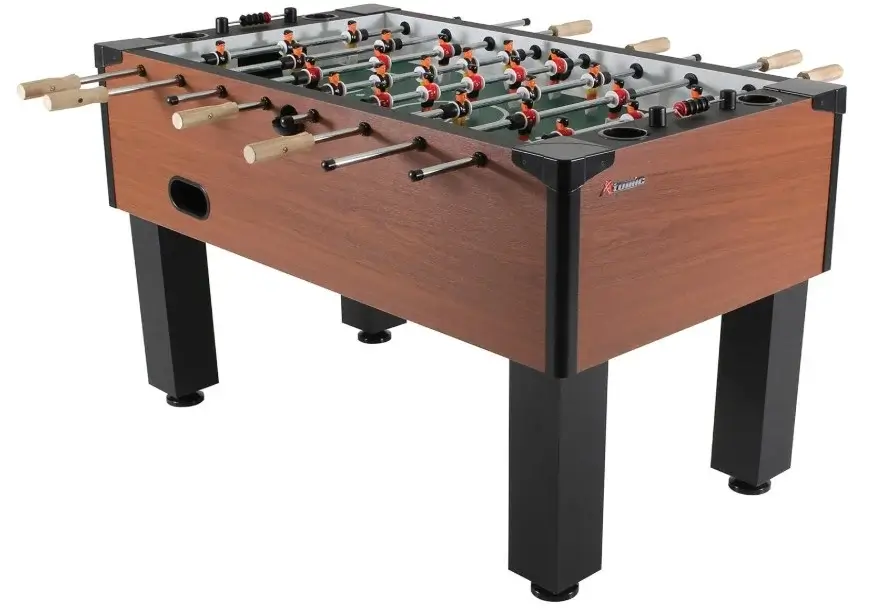
The Gladiator represents Atomic’s heavier, more traditional side.
It uses solid steel rods, solid wood handles, an internal ball return, abacus scoring, oversized levelers, and integrated cup holders. Four balls are included with the current model.
The cup holders are practical, although they do not improve passing accuracy.
They may still protect the playfield from a badly placed soda.
The Gladiator’s weight and solid rods make it the strongest choice for buyers who dislike lightweight movement.
Its main disadvantages are assembly effort and difficult relocation.
Atomic Pro Force 56

View Product
The Pro Force is Atomic’s more accessible full-size option.
The current version uses hollow chrome rods, rubber handles, robot-style players, manual slide scoring, a built-in ball return, and 3.5-inch levelers.
It is easier to approach than the heavier Gladiator.
That makes it suitable for beginners, children under supervision, and casual office play.
Buyers should verify the exact version before ordering.
The current official page describes a carbon-fiber appearance and two included balls. The same page also retains a separate reference to bamboo laminate. Older listings may show a bamboo finish and four balls.
Check the SKU, product images, included accessories, and manual.
Do not assume every Pro Force listing describes the same production version.
Atomic Foosball Table Assembly
Assembly is one of the biggest Atomic buyer concerns.
A good table can feel disappointing when misaligned rods, reversed players, or loose legs affect the first match.
What to Expect During Assembly
Most Atomic foosball tables require significant assembly.
The exact process depends on the model, but buyers commonly need to install:
- Cabinet panels
- Legs and braces
- Leg levelers
- Rods and bearings
- Player figures
- Handles
- Scoring components
- Ball-return parts
- Electronic connections on the Azure
Use two adults for heavy models.
The table often needs to be turned upright after the legs are attached. Trying this alone risks cabinet damage and personal injury.
Assemble the table near its permanent location.
A completed Gladiator or Azure is not something most buyers will casually carry upstairs later.
Finding the Correct Atomic Foosball Table Manual
Atomic foosball table assembly instructions should always match the exact model.
Escalade provides an online product manual library with brand filtering and manual search.
Before downloading an Atomic foosball table manual, confirm:
- The model number
- The SKU
- The cabinet finish
- The product dimensions
- The hardware shown
- The electronic layout, when applicable
The model number may appear on the carton, cabinet label, order record, or original manual.
Avoid using random Atomic foosball table instructions from a visually similar model.
A small production change can alter the hardware order, rod arrangement, or wiring route.
Common Assembly Mistakes
Several setup problems appear repeatedly across full-size Atomic tables.
Installing rods in the wrong sequence
Organize rods by player count before inserting them.
Facing players in the wrong direction
Check every figure before tightening it. Reversing an entire team is an impressive mistake, but not a useful one.
Overtightening screws
MDF needs firm connections, not crushed screw points.
Tightening everything too early
Start hardware loosely. Align the cabinet before completing the final tightening.
Skipping the levelers
Use a level after placing the table in its final position.
Pinching Azure cables
Keep wiring clear of cabinet joints, screws, and moving parts.
Turning the table alone
Use another adult. Heavy tables can twist while being lifted.
Atomic Foosball Table Durability and Reliability
Atomic durability depends on the model and how the table is treated.
Physical components usually create fewer concerns than electronic ones.
Steel rods, handles, manual scorers, and levelers can often be cleaned, tightened, or replaced. LED systems and electronic scoreboards require more specific parts.
The customer feedback supplied for this article shows several repeated patterns.
Azure owners often praise the illuminated experience and table stability. However, some report difficult assembly, shipping damage, or electronic problems.
Gladiator feedback is stronger around weight and sturdiness. Assembly remains mixed because the table is heavy and requires patience.
Pro Force buyers frequently describe it as beginner-friendly and enjoyable. Some also report broken or damaged pieces upon arrival.
These reports do not prove that every unit has the same problems.
Shipping damage can affect any large MDF product. Inspect the package before assembly and photograph visible damage immediately.
Watch for:
- Cracked cabinet panels
- Bent rods
- Loose player figures
- Damaged corners
- Missing hardware
- Broken scoring parts
- Pinched electrical cables
- Misaligned ball-return channels
Do not complete assembly when a structural panel is badly damaged.
Finishing the table may complicate a return or warranty claim.
Atomic Foosball Table Maintenance
Atomic tables do not require complicated maintenance.
They do require consistency.
Clean the playfield with a soft cloth. Remove dust before it collects around the walls and player feet.
Keep the rods clean.
Use only an appropriate lubricant in small amounts. Excess oil attracts dust and can spread onto handles or the playfield.
Check the following every few months:
- Cabinet bolts
- Leg connections
- Handles
- Player screws
- Rod bearings
- Scoring components
- Ball-return channels
- Leg levelers
Keep drinks away from MDF seams.
Even the Gladiator’s cup holders are not permission to baptize the cabinet with soda.
Azure owners should also inspect visible cables and connectors. Disconnect power before checking electronic components.
Never force a jammed ball-return mechanism.
Find the blockage first. Forcing the ball may separate an internal channel or damage a connection.
Atomic Replacement Parts and Customer Support
Replacement-part access is important because Atomic models use different hardware.
A Gladiator rod should not automatically be assumed compatible with an Azure or Pro Force.
Compatibility may depend on:
- Rod diameter
- Rod length
- Player attachment method
- Bearing size
- Handle design
- Scorer type
- Model year
- SKU
- Electronic connector type
Escalade states that replacement parts are available during the manufacturer’s warranty period. It also says parts may remain available afterward, with the customer covering applicable costs and shipping. Spare parts are stocked in the United States, and Escalade provides technical and after-sales support.
Warranty periods can vary.
Check the manual or warranty information for your exact Atomic foosball table.
When contacting support, prepare:
- Product model
- SKU
- Purchase date
- Seller information
- Photos of the problem
- Part number, when available
- Description of the fault
“Something broke near the blue player” is not the ideal support request.
Clear model and part information usually produces a faster answer.
Atomic Foosball Table Pros and Cons
Atomic’s main strengths come from variety and home-focused features.
Its weaknesses come from material limits, assembly demands, and model inconsistency.
Advantages
- Full-size tables suitable for adults
- Multiple designs for different home buyers
- Steel rods across major models
- Adjustable leg levelers
- Built-in ball returns
- Manual and electronic scoring options
- Distinctive visual designs
- Models suitable for families and beginners
- Official manuals and replacement-part support
Disadvantages
- Extensive assembly
- MDF or engineered-wood cabinets
- Heavy models can be difficult to move
- Product quality varies by model
- Shipping damage can affect large panels
- LED systems add possible failure points
- Some listings contain version inconsistencies
- Not primarily designed for professional tournament training
The biggest mistake is choosing by appearance alone.
A buyer impressed by Azure lighting may later dislike electronic maintenance. Someone choosing Pro Force for easy handling may later want a heavier cabinet.
Match the model to your priorities.
Who Should Consider an Atomic Foosball Table?
Atomic works best for buyers who want a substantial recreational table.
It may suit:
- Families playing regularly
- Beginners buying their first full-size table
- Casual adult players
- Offices with supervised recreation areas
- Buyers who value design
- Players wanting manual or electronic scoring
- Households needing adjustable levelers
Atomic may not suit:
- Serious tournament competitors
- Commercial venues with constant public use
- Buyers seeking solid-wood cabinets
- Outdoor installations
- Rooms with high moisture
- Buyers needing folding storage
- Anyone unable to manage significant assembly
Measure the room before buying.
Include space for the rods, players, and walking clearance. Cabinet dimensions alone do not show the full playing footprint.
Is Atomic Better Than Other Foosball Table Brands?
Atomic is better when the buyer values home entertainment, design, and feature variety.
It becomes less competitive when the priority is official tournament familiarity, commercial construction, or advanced ball control.
Atomic stands out through:
- LED presentation
- Modern cabinet styling
- Accessible recreational play
- Multiple scoring systems
- Full-size home designs
Other brands may be stronger in:
- Tournament certification
- Commercial durability
- Counterbalanced players
- Specialized player feet
- Long-term parts standardization
- Resale demand among competitive players
Atomic is not among the five official table brands identified for the 2026 ITSF World Champions League. That distinction matters for competitive players, but it should not decide every home purchase.
The better brand is the one that matches the intended use.
A tournament table can be unnecessary for occasional family play. A decorative table can frustrate someone practicing controlled passes every evening.
Final Verdict on Atomic Foosball Tables
Atomic is a credible recreational foosball brand with a clear identity.
It offers full-size tables with practical features, noticeable styling, and several levels of complexity.
The brand is strongest for families, beginners, casual adults, and office players.
Its tables are less suitable for professional training, commercial venues, or buyers demanding hardwood construction.
Among the brand’s designs:
- Azure shows Atomic’s entertainment-focused side
- Gladiator shows its heavier traditional side
- Pro Force shows its beginner-friendly side
Atomic is a good brand when buyers understand what it is built to provide.
Focus on cabinet stability, rod type, model support, and assembly quality. Treat lighting and decorative features as secondary considerations.
At Foosball Junkie, our practical rule is simple:
“The best table is not the flashiest one. It is the one that still feels right after the novelty wears off.”
Frequently Asked Questions
Is Atomic a good foosball table brand?
Yes, Atomic is a good recreational brand for families, beginners, and casual adults.
Its tables offer full-size play, steel rods, levelers, scoring systems, and built-in ball returns. Quality and features vary by model.
Who makes Atomic foosball tables?
Atomic is part of Escalade’s indoor games portfolio.
Escalade Sports sells and supports Atomic products, including manuals, warranties, technical help, and replacement parts.
Are Atomic foosball tables suitable for adults?
Yes.
The Azure, Gladiator, and Pro Force are full-size tables designed for adult-friendly play. Their stability differs, with Gladiator and Azure offering heavier construction than Pro Force.
Where can I find an Atomic foosball table manual?
Use Escalade Sports’ official product manual library.
Search by Atomic, model number, or SKU. Confirm that the dimensions, finish, and hardware match your table.
How difficult is Atomic foosball table assembly?
Difficulty varies by model.
Pro Force may feel more manageable because of its lighter weight. Gladiator and Azure usually require more effort and should be assembled by two adults.
Can I buy Atomic foosball table replacement parts?
Escalade provides replacement parts during applicable warranty periods. Parts may also remain available after warranty coverage ends.
Always provide the model number and part details.
Are Atomic foosball tables suitable for competitive players?
They can support casual competition and skill development.
However, Atomic is not currently listed among the official tables named for the 2026 ITSF World Champions League. Serious tournament players may prefer equipment used in their competition format.